Despite the uncertainty of the Federal Reserve raising rates, the ongoing U.S.-Iran conflict, elevated inflation, and midterm elections, Sterling Capital believes the resilience of corporate earnings, favorable seasonality, and reasonable valuations may allow U.S. equities to look through these concerns and continue advancing into 2027.
Strong earnings growth has resulted in a price-to-earnings multiple compression, thus equities are appearing not only undervalued, but may have higher quality characteristics relative to previous equity market peaks, similar to the “Tech Bubble” of 1999.
We believe earnings strength, favorable seasonality trends, moderate valuations, and higher quality characteristics may combine for an attractive set up for equities, possibly through the rest of 2026 and beyond.
Given the potential macro risks of the Federal Reserve (Fed) raising rates in September, the continuing U.S.-Iran conflict, elevated inflation, and midterm elections, how should investors position portfolio equity allocations?
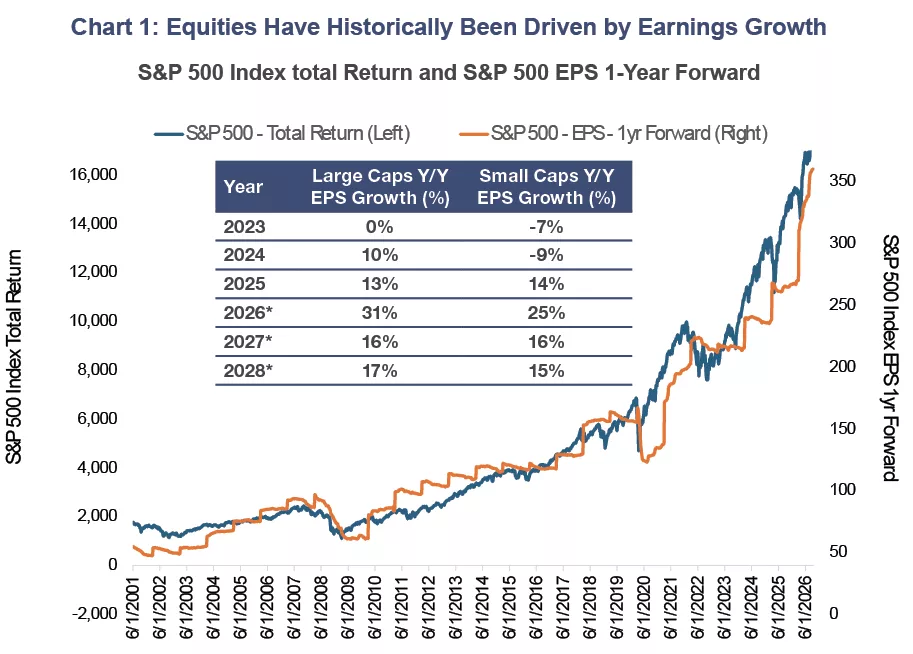
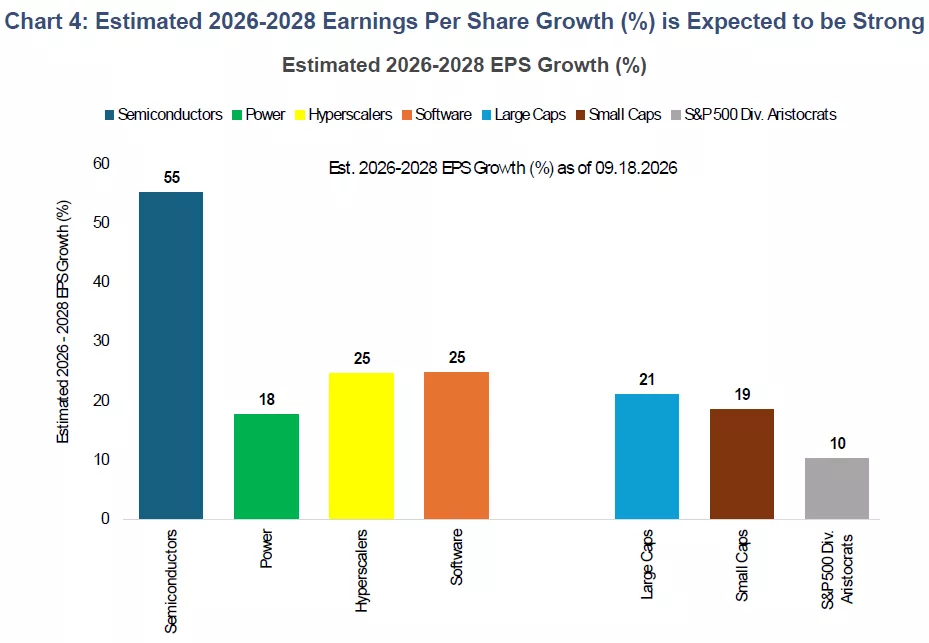
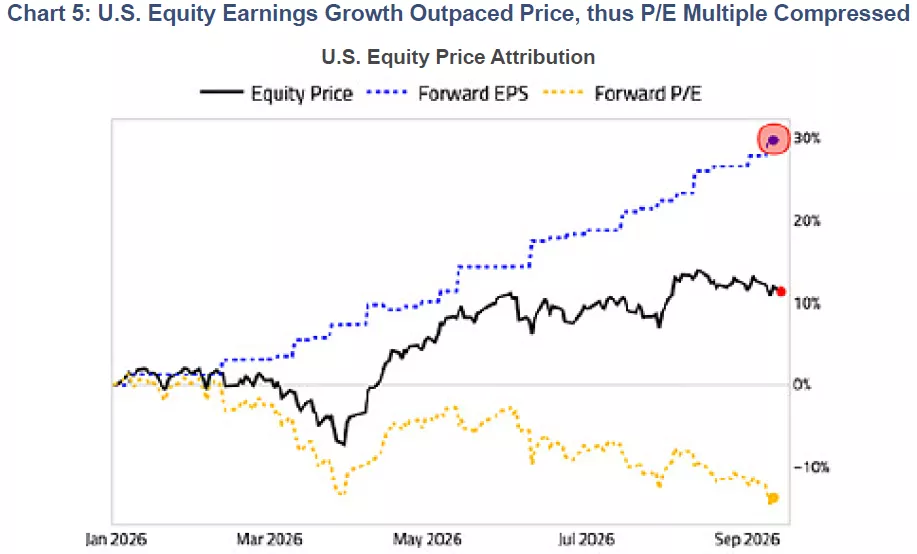
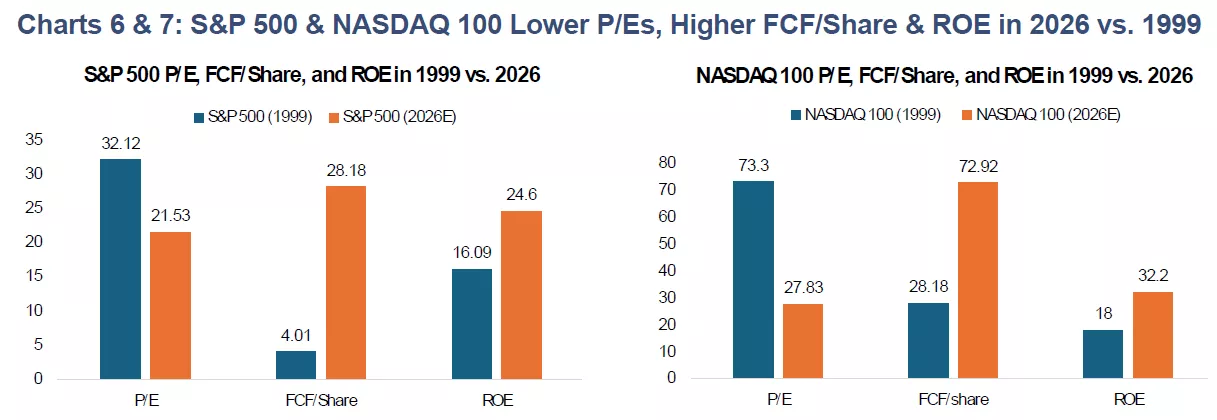
We believe the strength of earnings growth (chart 1) and attractive seasonality trends (chart 2) may power U.S. equities higher in the fourth quarter of 2026 and during 2027. We favor an overweight to equities, both in large and small caps, as earnings growth from 2026-2028 for the S&P 500 Index (large-caps) and S&P 600 (small-caps) could potentially be 21% and 19% per year, respectively (chart 4). The artificial intelligence (AI) capital expenditure (capex) spending cycle is expected to potentially drive strong earnings growth for equities from 2026 through 2028. Strong earnings growth appears to have resulted in price-to-earnings (P/E) (measure of valuation) compression (chart 5), having us believe that equities may actually be undervalued relative to earnings growth and high-quality characteristics. Compared to 1999, the S&P 500 and Nasdaq 100 Indexes are trading at lower P/E ratios, but appear to have higher free cash flow/share (FCF/Share) and return on equity (ROE) in 2026 (Chart 6 & 7).
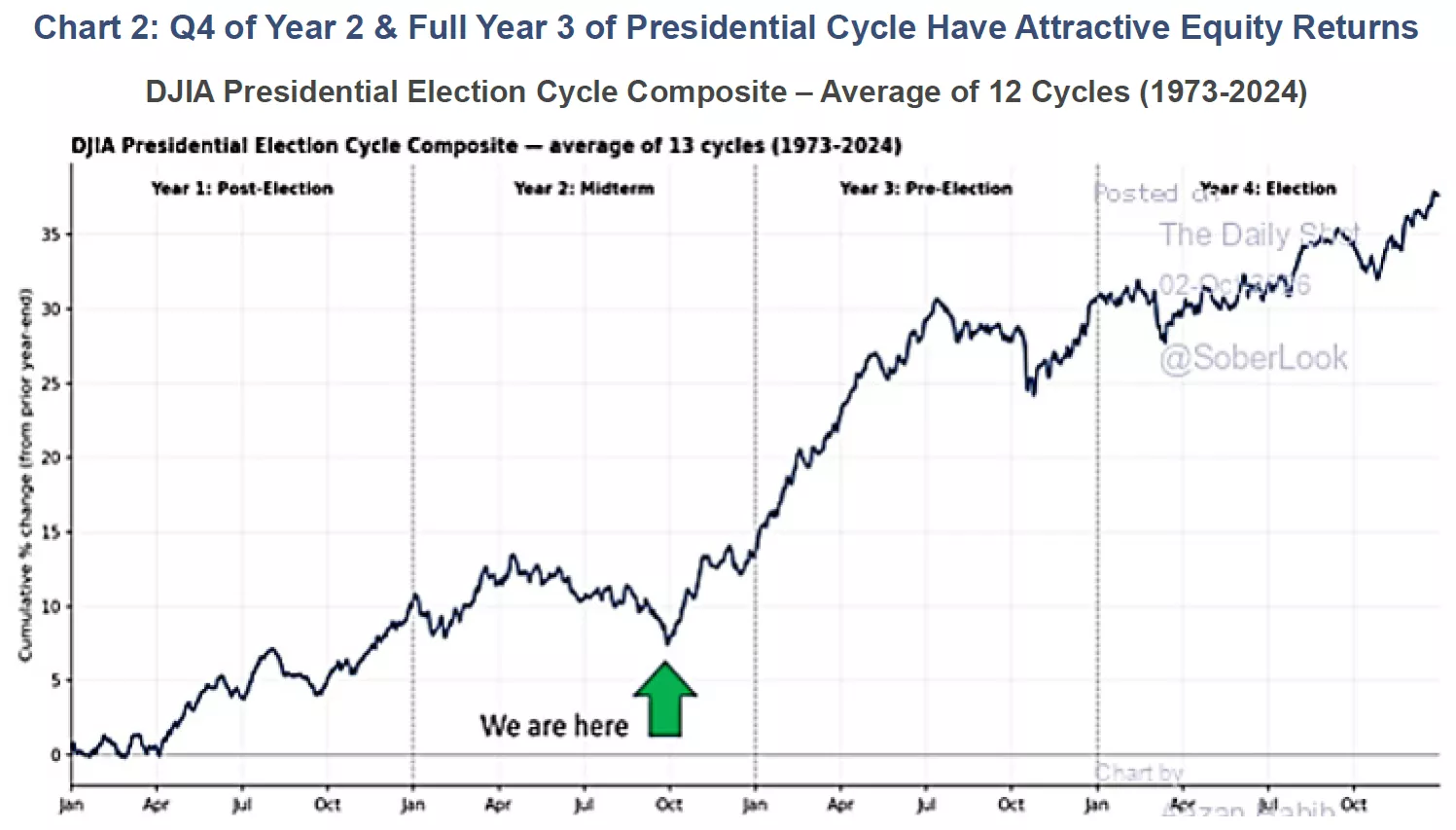
Despite concerns around the upcoming midterm election, history suggests October may be the best performing month of a midterm year with the S&P 500 Index historically averaging a 3% positive return.1 Additionally, the fourth quarter of a midterm year has also shown to be the best performing quarter, historically. Calendar year 2027 may benefit from this previous tendency of the third year of a presidential cycle to potentially experience an average return of 14.5% for the S&P 500 Index.2
We believe the strength U.S. stocks have historically shown in Q4 of midterm years, and in the third year of a presidential cycle, is that midterms have typically driven a shift in power in Congress to a gridlock in Washington (futures markets are potentially expecting gridlock in 2026). Gridlock is considered a “Goldilocks” scenario for equity markets, as in the past it has often appeared to reduce policy risk and uncertainty.
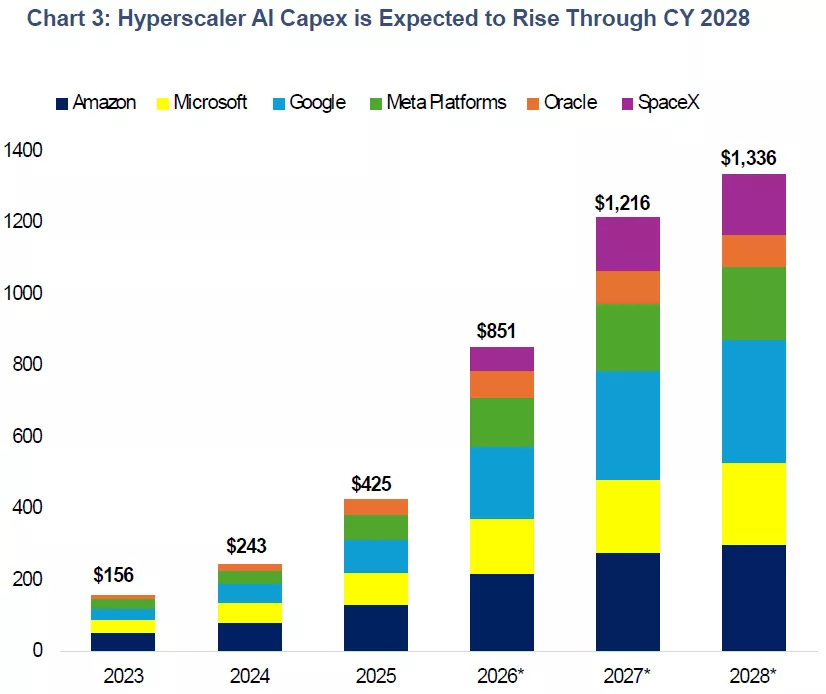
The hyperscalers of Amazon, Microsoft, Alphabet, Meta Platforms, and Oracle are planning to invest heavily in AI infrastructure with possibly $805B in 2026 and $1.1T in 2027 (chart 3), as hyperscalers are appearing to experience an acceleration of growth in their datacenter revenue growth due to rapid adoption of AI services. As more AI use cases like AI software coding tools and AI agents gain adoption, we believe the hyperscalers may continue to invest in infrastructure to meet the potentially rising demand of AI solutions. A recent example is Meta’s launch of its AI agent/personal assistant called “Muse,” which is the fastest iPhone app to reach 5M downloads in less than 2 weeks, however, there are more than approximately 7B smartphones on the planet, thus AI agents/assistants have only penetrated less than 1% of the total addressable market of all of these smartphones.
We believe the hyperscaler AI infrastructure spending is potentially the key driver of the strength of earnings growth for large caps (S&P 500 Index), which is expected to average 21% per year from 2026-2028 (chart 4). However, small caps may also benefit from the AI capex boom, with earnings growth expectations of 19% per year over the same time period (chart 4). Two sub-industries of semiconductors and power suppliers appear well positioned to supply solutions to the hyperscalers’s shortages, which is supported by the strength of the expected earnings growth for semiconductors and power suppliers from 2026-2028 (chart 4).
Thus far in 2026, the S&P 500 Index has generated a positive return (black line in chart 5), appearing to be driven by the strength of earnings (blue line in chart 5), while the forward P/E ratio (yellow line in chart 5) has actually contracted, making the Index less expensive than at the start of 2026.
We believe the P/E multiple compression in 2026 has occurred for several reasons: 1. Earnings appear to have grown faster than prices, 2. Rising bond yields and interest rates appear to raise the discount rate applied to future cash flows, and investors are less willing to pay a higher multiple for future earnings, 3. Some investors may believe stocks are over-earning in the short-term, and that elevated earnings won’t continue for the long-term.
We believe the equity earnings strength may continue through 2028 (chart 4), and that equities may actually be undervalued relative to their strong earnings growth.
Compared to 1999, the S&P 500 and Nasdaq 100 Indexes appear to be trading at substantial discounts in 2026 relative to the peak P/E multiples in the tech bubble of 1999. In our view, this discount to previous peak P/E valuations may provide investors with a potential margin of cushion for equity investors. Not only are the P/E multiples in today’s market appearing significantly lower than the peak of 1999, but the FCF/share and the ROE is higher, which may imply today’s equities could be of higher quality and possibly generating more cash flow relative to 1999.
Bottom-line, we believe the earnings strength, favorable seasonality trends, moderate valuations, and higher quality characteristics of today’s equities could combine for an attractive set-up for equities through the rest of 2026 and beyond.
About the Author

Whitney Stewart, CFA®, Executive Director, joined SCM in 2018 and has industry experience since 2005. Whitney is a Client Portfolio Manager, focusing on SCM's Equity franchise. Prior to joining SCM, he was a portfolio specialist supporting the sales effort with the various affiliates within AMG Funds. Before his time at AMG, he was a research analyst and investment counselor with Fisher Investments. Whitney received his B.A. in Economics from University of North Carolina at Chapel Hill. He holds the Chartered Financial Analyst® designation.
Related Insights
08.03.2026
James Kerin, CFA®, Michael McVicker